
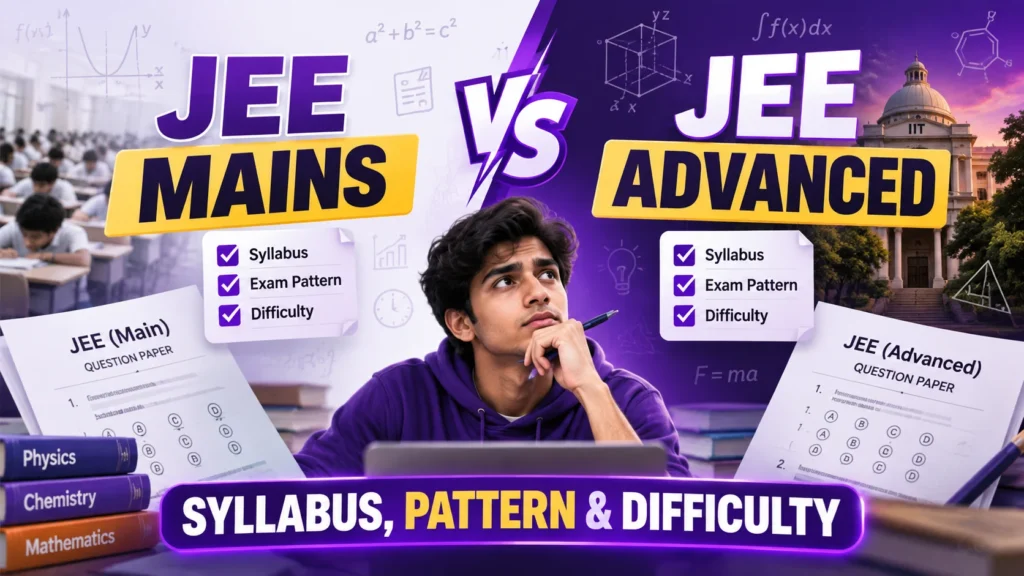
JEE Mains vs JEE Advanced is the first comparison every engineering aspirant in India needs to understand. JEE Main, conducted by the National Testing Agency (NTA), is the entrance test for NITs, IIITs and other centrally funded technical institutes (GFTIs). It is also the qualifier for JEE Advanced. JEE Advanced, conducted by one of the IITs on a rotating basis, is the tougher exam that decides admission to the IITs. This guide compares both exams on syllabus, exam pattern, difficulty, eligibility, cutoffs, counselling and preparation. It also includes a section on what to expect from JEE Main 2027 and JEE Advanced 2027.
Quick Comparison Table
| Feature | JEE Main | JEE Advanced |
|---|---|---|
| Conducted by | National Testing Agency (NTA) | One of the seven older IITs, rotating each year under the Joint Admission Board |
| Purpose | Admission to NITs, IIITs and other participating institutions; also serves as the qualifying exam for JEE Advanced | Admission to undergraduate programs at IITs |
| Who can appear | Class 12 passed or appearing candidates who meet the eligibility criteria | Candidates who qualify JEE Main and fall within the prescribed cutoff for JEE Advanced |
| Mode | Computer-based test; the drawing test in Paper 2A is conducted on paper | Computer-based test |
| Papers | Paper 1: B.E./B.Tech; Paper 2A: B.Arch; Paper 2B: B.Planning | Paper 1 and Paper 2, both compulsory |
| Duration | 3 hours | 3 hours per paper |
| Subjects (B.Tech) | Physics, Chemistry and Mathematics | Physics, Chemistry and Mathematics |
| Question types | Multiple-choice questions and numerical value questions | Question types vary by year and may include single-correct, multiple-correct, numerical, matching and paragraph-based questions |
| Attempts | Two sessions per year, subject to the applicable eligibility rules | Two attempts in two consecutive years, subject to eligibility rules |
| Difficulty | Generally emphasizes speed, accuracy and application of concepts | Generally emphasizes deeper conceptual understanding, analytical thinking and problem-solving |
| Counselling | JoSAA and CSAB, along with applicable state counselling processes | JoSAA |
JEE Main 2027 vs JEE Advanced 2027: What to Expect
The 2027 cycle has not been fully notified yet, so the dates and details below are expected ones based on the last few years. They will be updated once NTA and the organising IIT release official notices.
2027 Expected Timeline
| Aspect | JEE Main 2027 | JEE Advanced 2027 |
|---|---|---|
| Conducting body | National Testing Agency (NTA) | IIT Delhi, expected based on the usual rotation |
| Notification and registration | Session 1 notification and registration expected around October–November 2026 | Registration expected around April 2027 |
| Exam window | Session 1 expected in January 2027; Session 2 expected in April 2027 | Expected around mid-May 2027 |
| Eligibility | Candidates who passed Class 12 in 2025 or 2026, or are appearing in 2027, subject to the official eligibility criteria | Candidates among the top 2.5 lakh JEE Main 2027 qualifiers who meet the applicable Class 12 and other eligibility requirements |
What’s New or Different in 2027
At the time of writing, no major syllabus change has been announced for either exam. What changes each year is the paper itself. Each organising IIT sets its own JEE Advanced paper, so the style, length and balance of question types can shift from one year to the next. JEE Main has also seen pattern revisions in recent years, including changes to the numerical section, so read the 2027 information bulletin closely when it is released.
What to Expect in the Paper
Based on recent trends, JEE Main papers have stayed moderate in difficulty and have rewarded students who are strong in NCERT-linked concepts and calculation speed. JEE Advanced has alternated between lengthy papers and concept-heavy ones, and it has often tested more than one idea inside a single question. This is a trend analysis and not official data. Expect the same broad approach in 2027, but do not bet on any single chapter or question type.
How to Prepare Around the 2027 Timeline
If you are in Class 12 and aiming for 2027, the January session is only a few months away, so your priority is completing the syllabus and starting full-length mock tests as early as possible. Use Session 1 as a live test and Session 2 as your improvement attempt. If you are in Class 11, your target is strong fundamentals now and the 2028 cycle later. Your plan should be built around Advanced-level concepts, with Main-level speed added through regular timed practice. The full plan is in the preparation strategy section below.
What Is JEE Mains?
JEE Main is a national-level engineering entrance exam conducted by the NTA. It is held twice a year, once in January and once in April. Candidates can appear in one or both sessions, and the better result is used for ranking. Paper 1 is for B.E./B.Tech admissions, Paper 2A is for B.Arch and Paper 2B is for B.Planning.
A good JEE Main rank gets you into the NITs, IIITs and GFTIs through JoSAA counselling. Many state governments and private universities also accept JEE Main scores for their engineering programmes. Beyond admissions, JEE Main has a second job: the top 2.5 lakh Paper 1 qualifiers earn the right to register for JEE Advanced. For most students, JEE Main is therefore both a destination exam and a gateway exam.
What Is JEE Advanced?
JEE Advanced is the entrance exam for the Indian Institutes of Technology. It is organised each year by one of the seven older IITs, chosen by rotation under the Joint Admission Board (JAB). IIT Kanpur held the 2025 exam, IIT Roorkee held the 2026 exam, and IIT Delhi is expected to conduct the 2027 exam.
Only candidates who qualify through JEE Main can register, and the exam tests the same three subjects at a much deeper level. A qualifying JEE Advanced rank gives you access to IIT seats in JoSAA counselling. Most IIT B.Tech and integrated programmes admit students only through this route, which is why JEE Advanced is treated as the most competitive stage of the process.
Eligibility Criteria Compared
| Criterion | JEE Main 2027 | JEE Advanced 2027 |
|---|---|---|
| Class 12 qualification | Passed Class 12 in 2025 or 2026, or appearing in 2027, subject to the official eligibility criteria | Passed Class 12 in 2025 or 2026, or appearing in 2027, with the applicable first-appearance requirement |
| Age limit | No age limit, subject to the eligibility conditions specified for the examination | Age limit applies. For JEE Advanced 2027, the cutoff date will be specified in the official information brochure |
| Attempts | Candidates can appear in two sessions in a year, subject to the applicable three-consecutive-year eligibility window | Two attempts in two consecutive years |
| Performance requirement | No JEE Main rank requirement to appear | Must be among the top 2.5 lakh candidates in JEE Main Paper 1, subject to category-wise and other eligibility criteria |
| Earlier IIT admission | Not applicable | Candidates who have previously accepted an IIT seat may be ineligible, subject to the specific rules and exceptions announced for the examination year |
One rule catches many students by surprise. The 75% Class 12 requirement (or being in the top 20 percentile of your board) applies to admission in IITs, NITs and other JoSAA institutes, not to appearing in the exam. The requirement is 65% for SC, ST and PwD candidates. Always verify the exact rule in the official brochure of the year you are applying.
Syllabus Comparison
Common Syllabus
Both exams are based on the Class 11 and Class 12 syllabus of Physics, Chemistry and Mathematics, so a large share of chapters is common. JEE Main follows a rationalised syllabus aligned closely with NCERT. JEE Advanced uses a syllabus published by the organising IIT in its brochure, and it usually looks similar in chapters but demands much more from each of them.
Physics, Chemistry and Maths: Where the Depth Differs
| Subject | Core Topics Common to Both | How JEE Advanced Goes Deeper |
|---|---|---|
| Physics | Mechanics, thermodynamics, electrostatics, current electricity, magnetism, optics and modern physics | Problems often combine multiple concepts and require careful reasoning, approximation, mathematical interpretation and application rather than direct formula use |
| Chemistry | Physical chemistry: mole concept, equilibrium, thermodynamics, kinetics and electrochemistry; Organic chemistry: general organic chemistry, hydrocarbons and carbonyl compounds; Inorganic chemistry: periodic table, chemical bonding and coordination compounds | Organic chemistry can test reaction mechanisms and multi-step transformations; inorganic chemistry emphasizes conceptual reasoning and application; physical chemistry often involves multi-step numerical problems |
| Mathematics | Algebra, calculus, coordinate geometry, trigonometry, vectors, 3D geometry and probability | Questions can involve multi-step reasoning, function analysis, complex numbers and the integration of concepts from multiple mathematical topics |
Topics Only in One Exam
The two syllabuses do not match exactly. JEE Main includes a few topics that JEE Advanced leaves out, and JEE Advanced retains some deeper topics that were trimmed from the JEE Main syllabus after rationalisation. The safest method is to compare the official JEE Main syllabus from the NTA website with the JEE Advanced syllabus in the current brochure, chapter by chapter.
Recent Changes
NTA rationalised the JEE Main syllabus in recent years and removed some chapters. The JEE Advanced syllabus has stayed largely stable, and no major change has been announced for 2027 at the time of writing. Check jeemain.nta.nic.in and jeeadv.ac.in before you finalise your study plan.
High-Weightage Chapters
This is a general trend from past papers, not an official weightage.
| Subject | JEE Main: Frequently Tested Chapters | JEE Advanced: Frequently Tested Chapters |
|---|---|---|
| Physics | Current electricity, modern physics, mechanics, optics and electrostatics | Mechanics, especially rotation and energy; electromagnetism, optics and modern physics |
| Chemistry | Chemical bonding, coordination compounds, equilibrium, thermodynamics, general organic chemistry and hydrocarbons | Organic reactions and mechanisms, coordination compounds, electrochemistry, equilibrium and kinetics |
| Mathematics | Calculus, coordinate geometry, matrices and determinants, probability, vectors and 3D geometry | Calculus, algebra including complex numbers, coordinate geometry, probability and combinatorics |
Exam Pattern Compared
JEE Main Pattern (Paper 1, B.E./B.Tech)
Paper 1 carries 75 questions to be answered for 300 marks, with 25 questions in each of Physics, Chemistry and Mathematics. Each subject has Section A with 20 MCQs and Section B with numerical value questions. The paper runs for 3 hours (4 hours for eligible PwD candidates) and is available in multiple languages including English, Hindi and several regional languages.
| Subject | Section A: MCQs | Section B: Numerical Value Questions | Total Marks |
|---|---|---|---|
| Physics | 20 questions | 5 questions to attempt | 100 |
| Chemistry | 20 questions | 5 questions to attempt | 100 |
| Mathematics | 20 questions | 5 questions to attempt | 100 |
| Total | 60 questions | 15 questions | 300 marks |
Each correct answer earns 4 marks, and each incorrect MCQ costs 1 mark. Unattempted questions carry no marks. The rules for the numerical section have been revised over the years, including the number of questions offered and the negative marking clause. Recent papers have made all five numerical questions in each subject compulsory. Confirm both points in the official 2027 information bulletin before the exam.
Paper 2A (B.Arch) and Paper 2B (B.Planning) are each worth 400 marks. Both include Mathematics (100 marks) and an Aptitude Test (200 marks). The third part is a Drawing Test worth 100 marks in Paper 2A and a Planning Test worth 100 marks in Paper 2B.
JEE Advanced Pattern
JEE Advanced has two compulsory papers, Paper 1 and Paper 2, and each paper has Physics, Chemistry and Mathematics sections. The exam is computer-based, and each paper is 3 hours long. Recent editions have held Paper 1 in the morning and Paper 2 in the afternoon on the same day.
| Element | What the Exam Does | What It Means for You |
|---|---|---|
| Question types | May include single-correct, multiple-correct, numerical answer, matching and paragraph-based questions, with the pattern subject to change each year | Practise different question formats instead of relying on a single approach |
| Marking scheme | Announced each year in the official information brochure; some question types may have partial marking, while certain formats may carry negative marking | Check the marking scheme carefully before the exam and plan your attempts accordingly |
| Papers | Both Paper 1 and Paper 2 are compulsory, and the final result is based on performance across both papers | Maintain consistent preparation and accuracy throughout both papers |
| Language | The examination is available in English and Hindi | Select the language in which you are most comfortable reading and solving questions |
Key Difference in Question Style
JEE Main questions are mostly direct, single-concept and time-bound, which makes speed and accuracy the deciding factors. JEE Advanced questions are layered, so one problem may combine mechanics with calculus or organic reasoning with stoichiometry. This is why students who practise only for speed struggle in Advanced, and students who practise only deep problems can run out of time in Main.
Which Is Tougher? Difficulty Comparison
JEE Advanced is considered tougher than JEE Main by a clear margin, even though the chapters overlap. The reason is the kind of difficulty. JEE Main is difficult because of its scale and speed: you must solve around 75 questions in 3 hours while avoiding silly mistakes. JEE Advanced is difficult because of depth: you get fewer questions per hour, but each one can demand several steps of original thinking. The table below is a general view based on past papers and student feedback, not official data.
| Subject | JEE Main: General View | JEE Advanced: General View |
|---|---|---|
| Physics | Generally emphasizes fundamental concepts, direct applications and efficient problem-solving, with several questions linked to the prescribed syllabus | Often requires deeper conceptual understanding, multi-concept application and careful reasoning |
| Chemistry | Strong emphasis on core concepts and syllabus-based preparation, with NCERT particularly useful for inorganic chemistry | Can require greater application of concepts, including organic reaction mechanisms, physical chemistry calculations and inorganic reasoning |
| Mathematics | Often involves substantial calculation and application of standard concepts | Frequently requires multi-step reasoning, deeper conceptual application and non-routine problem-solving |
Application Process and Fees
JEE Main registration is done on the NTA website (jeemain.nta.nic.in). Candidates create an account, fill in personal and academic details, upload a photograph, signature and required documents, choose exam cities, and pay the fee online. Registration is done separately for each session.
JEE Advanced registration opens only for candidates who qualify through JEE Main, usually in April or May, after the second session result. The steps are:
- Visit jeeadv.ac.in and log in with your JEE Main credentials.
- Verify your details and choose your exam cities.
- Upload the required documents, such as your photograph, signature, Class 10 certificate, ID proof and category certificate if applicable.
- Pay the registration fee online and submit the form.
Fees differ by category and gender for both exams, and JEE Advanced usually charges less for female, SC, ST and PwD candidates. The exact amounts change from year to year, so check the current figures on the official websites. Keep scanned copies of all documents ready, because a mismatched name or date of birth is the most common cause of rejected applications.
Marks, Percentile and Rank
JEE Main results are reported as NTA scores in the form of percentiles. Because the exam runs in multiple shifts, NTA uses normalisation to make results comparable across shifts. A percentile shows the share of candidates in your session who scored at or below your score. If a candidate appears in both sessions, the better score is used to prepare the rank list. The All India Rank is then prepared from these scores, and tied candidates are separated using rules such as subject-wise scores and, in some cases, age. The exact order of tie-breakers is listed in the information bulletin.
JEE Advanced works differently because it reports raw marks. Your rank comes from the combined marks of Paper 1 and Paper 2, and there is no percentile conversion. To receive a rank, you must clear the minimum marks in each subject and in the aggregate. Qualifying candidates get a Common Rank List (CRL) rank and a category rank if they belong to a reserved category. Tie-break rules are given in the brochure, and they usually depend on positive marks and subject-wise scores.
Cutoffs
Cutoffs work at different levels in this process, and students often mix them up.
| Cutoff Type | What It Means | Where to Check |
|---|---|---|
| JEE Main cutoff for JEE Advanced eligibility | The category-wise cutoff percentile used to determine eligibility for JEE Advanced. It corresponds to the performance threshold for candidates included among the prescribed number of JEE Main qualifiers | JEE Main official website |
| JEE Advanced qualifying cutoff | The minimum subject-wise and aggregate marks required to qualify for a rank in JEE Advanced. The qualifying marks are announced separately for different categories | JEE Advanced official website |
| Admission cutoff: Opening and closing ranks | The opening and closing ranks for specific institutes, programs and categories in different JoSAA counselling rounds | JoSAA official website |
Counselling and College Admission
Both exams lead to the same counselling process, the Joint Seat Allocation Authority (JoSAA), which manages seat allocation for the IITs, NITs, IIITs and GFTIs. Candidates register, fill their choices in order of preference, and go through multiple rounds of allotment. In each round you can accept your seat, freeze it, or float or slide to improve your choice in the next round. After JoSAA ends, the Central Seat Allocation Board (CSAB) runs special rounds for the NITs, IIITs and GFTIs, and many states run their own counselling for state colleges.
| Exam / Result | Institutes or Programs It Can Open | Counselling / Admission Process |
|---|---|---|
| JEE Advanced rank | Undergraduate programs at IITs | JoSAA |
| JEE Main Paper 1 rank | NITs, IIITs and other participating institutes, including GFTIs | JoSAA, followed by CSAB special rounds where applicable |
| JEE Main Paper 1 score | State engineering colleges and participating private universities that accept JEE Main scores | State counselling authorities or the respective university/institute |
| JEE Main Paper 2A | B.Arch programs at NITs and other participating institutes | JoSAA and CSAB, where applicable |
| JEE Main Paper 2B | B.Planning programs at NITs and other participating institutes | JoSAA and CSAB, where applicable |
Preparation Strategy for Both Exams
- Class 11 vs Class 12 plan – Class 11 is the best time to build conceptual depth, since chapters like mechanics, general organic chemistry, algebra and calculus form the base for Class 12 topics. Finish Class 11 concepts with problem-solving practice by the end of the year. In Class 12, complete the remaining syllabus by the end of the year’s first half if possible, then move to full-length tests and revision.
- Mains first or Advanced first? – Do not treat them as separate plans. Prepare for the depth of Advanced and add the speed of Main on top. A student with strong concepts can improve speed through timed practice much faster than a student with weak concepts can build depth in the last few months. Since you must clear JEE Main to reach Advanced, keep timed Main-style practice in your weekly schedule from the start.
- Coaching vs self-study – Coaching offers structure, a peer group and test series, while self-study offers flexibility and lower cost. Both can work. What matters is whether you have a clear syllabus schedule, quality problem sets, regular tests and honest analysis of your mistakes. Students who study alone should join a good test series, and students in coaching should still practise independently every day.
- Mock tests and previous year papers – Solve JEE Main papers from the last several years and JEE Advanced papers of at least the last ten years. Use NTA’s official practice resources and the official JEE Advanced mock test on jeeadv.ac.in. After every test, spend as much time reviewing errors as you did solving.
- Time management in the exam – In Main, attempt your strongest subject first, mark difficult questions and return to them, and do not spend more than a few minutes on a single question. In Advanced, read the whole section quickly, attempt the questions you are confident about first, and avoid negative-marked guesses unless you can eliminate options.
Best Books and Resources
| Subject | Concept Building | Practice and Advanced-Level Problems |
|---|---|---|
| Physics | NCERT Class 11 and 12; H.C. Verma’s Concepts of Physics | D.C. Pandey series; I.E. Irodov for selected advanced-level practice |
| Chemistry | NCERT Class 11 and 12, particularly important for inorganic chemistry; N. Avasthi for physical chemistry | M.S. Chouhan for organic chemistry; J.D. Lee for inorganic chemistry concepts; O.P. Tandon for additional practice |
| Mathematics | NCERT Class 11 and 12; S.L. Loney for trigonometry and coordinate geometry | Cengage Mathematics series by G. Tewani; Arihant books by Amit M. Agarwal for algebra and calculus |
Common Mistakes Students Make
- Treating JEE Main as an easy exam and starting serious preparation late
- Ignoring NCERT, especially for inorganic chemistry, which appears heavily in Main
- Collecting many books and finishing none of them
- Taking tests but not analysing mistakes afterwards
- Practising only speed for Main and only depth for Advanced, when both are needed
- Neglecting board exam preparation, which affects the 75% eligibility for admission
- Following unofficial dates and rules instead of official notices
Important Dates Timeline
| Stage | JEE Main 2027 (Expected) | JEE Advanced 2027 (Expected) |
|---|---|---|
| Notification and registration | Session 1: October–November 2026; Session 2: around February–March 2027 | April–early May 2027 |
| Exam | Session 1: January 2027; Session 2: April 2027 | Mid-May 2027 |
| Result | Session-wise results are generally released within a few weeks of the respective examination | Expected in early June 2027 |
| Counselling | JoSAA registration is expected to begin after the JEE Advanced result, usually in June | JEE Advanced-qualified candidates participate through the JoSAA counselling process |
FAQs
- Is JEE Advanced harder than JEE Main?
Yes. Both exams use similar chapters, but JEE Advanced asks deeper, multi-concept questions with less predictable patterns, while JEE Main is a moderate-difficulty test that rewards speed and accuracy. - Can I write JEE Advanced without JEE Main?
No. Indian candidates must qualify through JEE Main Paper 1 and rank in the top 2.5 lakh to register. Foreign nationals follow a separate registration route. - Is the syllabus the same for both exams?
The core of Class 11 and 12 Physics, Chemistry and Mathematics is common, but the two syllabuses are not identical. JEE Advanced tests the shared topics in greater depth, and each exam has some topics the other leaves out. - How many attempts are allowed?
JEE Main is available for three consecutive years, with two sessions each year. JEE Advanced allows a maximum of two attempts in two consecutive years. - Is JEE Main enough for a good college?
Yes, for NITs, IIITs, GFTIs and many top state and private colleges. Only the IITs require JEE Advanced. - Can I get into an IIT through JEE Main alone?
No. IIT admission is based on your JEE Advanced rank. JEE Main only qualifies you to sit for Advanced. - Which exam should I prepare for first?
Prepare for both together. Build Advanced-level concepts and add timed Main-style practice, because a strong base helps in both exams. - Are both exams online?
Both are computer-based tests. The one exception is the Drawing Test in JEE Main Paper 2A, which is done on paper. - When is JEE Advanced 2027?
The official date is yet to be announced. Based on previous cycles, it is expected in mid-May 2027. Check jeeadv.ac.in for the notification. - Which IIT will conduct JEE Advanced 2027?
IIT Delhi is expected to be the organising institute, following the Joint Admission Board’s rotation. Official confirmation will come with the brochure.
Conclusion
The difference between the two exams is simple: JEE Main is your entry to NITs and IIITs and your ticket to JEE Advanced, and JEE Advanced is the deeper test that opens the IITs. The best approach is to prepare for both together, with strong concepts as the foundation and timed practice on top. For a step-by-step plan, read our complete JEE preparation strategy guide.