
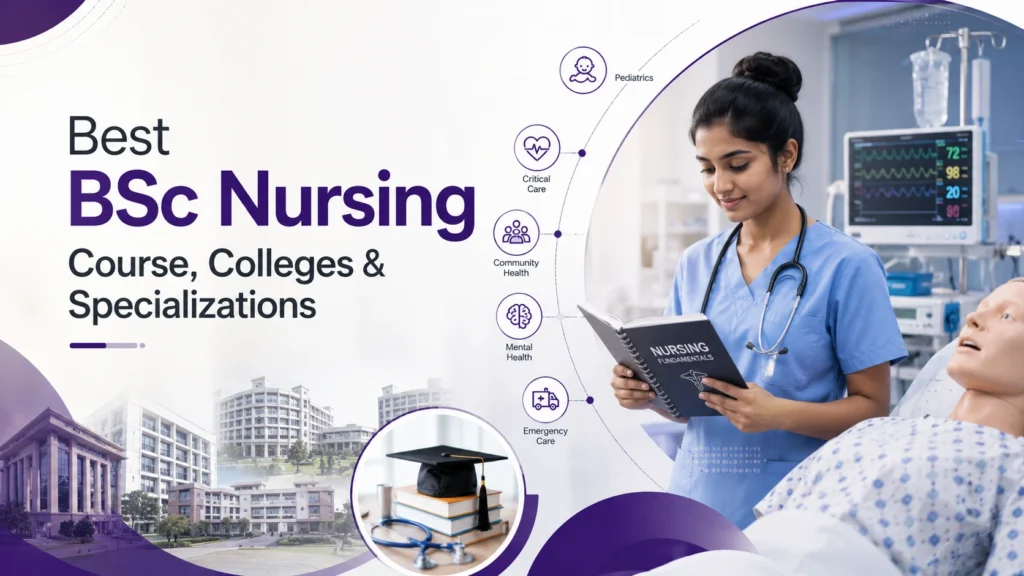
If you are exploring healthcare as a career, BSc Nursing is one of the most respected and in demand paths you can choose. It combines science, patient care, and real world impact, and it opens doors to opportunities across hospitals, communities, and research settings worldwide. This article breaks down everything you need to know about the BSc Nursing course, how to pick the right college, and which specializations can shape your career for years to come.
What Is BSc Nursing?
BSc Nursing, short for Bachelor of Science in Nursing, is an undergraduate degree that prepares students to become registered, professionally qualified nurses. The BSc Nursing course blends classroom learning in subjects like anatomy and pharmacology with hands on clinical training in hospitals and community health settings.
Unlike shorter diploma programs, a BSc Nursing degree gives graduates a stronger foundation in critical thinking, leadership, and evidence based patient care, which is why it is increasingly preferred by employers and healthcare systems around the world.
Eligibility Criteria for BSc Nursing Course
Eligibility requirements vary by country and institution, but most programs share similar core expectations. The table below outlines general global guidelines.
| Requirement | General Guideline | Notes |
|---|---|---|
| Educational Background | Completion of secondary or high school education with science subjects (Biology, Chemistry, and Physics) | Some countries require a minimum grade average in these subjects |
| Age Limit | Typically 17 to 35 years, depending on the country and university | A few institutions have no strict upper age limit |
| Entrance Exam | Many universities require a nursing or general science entrance examination | Requirements differ widely, so always check with the specific institution |
| Language Proficiency | English or the local language of instruction, often verified through a proficiency test | Particularly important for international applicants |
BSc Nursing Course Duration and Structure
Most BSc Nursing programs run for four years, though some accelerated or bridge programs for existing healthcare workers can be shorter. The course is generally divided into theory heavy early years and clinically intensive later years.
| Year | Primary Focus | Typical Learning Format |
|---|---|---|
| Year 1 | Foundational sciences and nursing basics | Classroom lectures with introductory laboratory work |
| Year 2 | Medical-surgical nursing and patient care fundamentals | Combination of theoretical instruction and supervised clinical practice |
| Year 3 | Specialized nursing areas such as pediatric and psychiatric care | Extensive hospital and community clinical placements |
| Year 4 | Advanced nursing practice, research, and leadership | Independent clinical rotations and a final research project |
Core Subjects Covered in BSc Nursing Course
A well rounded BSc Nursing curriculum covers a mix of biological sciences, clinical nursing practice, and social sciences. Common subjects include:
- Anatomy and Physiology
- Microbiology and Biochemistry
- Fundamentals of Nursing
- Medical Surgical Nursing
- Community Health Nursing
- Pharmacology
- Psychology and Mental Health Nursing
- Pediatric Nursing
- Obstetrics and Gynecological Nursing
- Nursing Research and Biostatistics
- Nursing Management and Leadership
These subjects work together to build both scientific understanding and practical caregiving skills, which is the core strength of any strong BSc Nursing course.
How to Choose the Best BSc Nursing College or University
Picking the right institution matters just as much as the course content itself. Here are the key factors to evaluate.
| Factor | Why It Matters | What to Check |
|---|---|---|
| Accreditation | Ensures your degree is recognized by employers and licensing bodies globally | Confirm accreditation with the relevant national nursing council or education authority |
| Clinical Exposure | Hands-on training determines your job readiness after graduation | Ask about hospital partnerships, clinical hours, and simulation laboratory facilities |
| Faculty Expertise | Experienced faculty enhance teaching quality, mentorship, and research opportunities | Review faculty qualifications, clinical experience, and areas of specialization |
| Global Recognition | Influences your ability to work or pursue further studies in other countries | Check whether graduates have obtained international placements or license transfers |
| Support Services | Helps students succeed academically and manage personal challenges | Look for counseling services, career guidance, placement support, and student wellness resources |
Best BSc Nursing Colleges in 2026
According to the QS World University Rankings by Subject 2026, nursing education continues to be led by a mix of long established medical universities across North America, Europe, and Asia Pacific. The University of Pennsylvania holds the top position globally for nursing, followed by King’s College London in second place. The United States, United Kingdom, and Australia continue to lead globally in nursing education according to the same rankings.
| Region | Notable Institutions | Known For |
|---|---|---|
| North America | University of Pennsylvania, Johns Hopkins University, University of Washington | Strong research output, advanced simulation laboratories, and extensive specialization opportunities |
| Europe | King’s College London | Strong emphasis on public health, healthcare policy, and mental health nursing programs |
| Asia Pacific | Leading universities in Australia and Singapore | Growing international student support, modern healthcare facilities, and strong clinical placement networks |
Specializations After BSc Nursing
One of the biggest advantages of a BSc Nursing course is the range of specializations available once you graduate. Choosing a specialization allows you to focus your skills and often leads to higher earning potential.
| Specialization | Focus Area | Common Work Settings |
|---|---|---|
| Pediatric Nursing | Care for infants, children, and adolescents | Children’s hospitals, pediatric clinics |
| Critical Care Nursing | Managing acutely ill patients requiring intensive monitoring | Intensive Care Units (ICUs), emergency departments |
| Oncology Nursing | Supporting patients through cancer diagnosis and treatment | Cancer centers, hospital oncology wards |
| Psychiatric and Mental Health Nursing | Care for patients with mental health conditions | Psychiatric hospitals, community mental health programs |
| Community Health Nursing | Preventive care, health promotion, and community education | Public health departments, rural health centers |
| Nurse Midwifery | Maternal, prenatal, and newborn care | Maternity wards, birthing centers |
Career Opportunities After BSc Nursing
Graduates of a BSc Nursing course are not limited to hospital bedside roles. Career paths include:
- Staff Nurse in hospitals and clinics
- Community and Public Health Nurse
- Nurse Educator in academic institutions
- Nurse Researcher
- Clinical Nurse Specialist
- Healthcare Administrator or Manager
- Travel or International Nurse
Global demand for qualified nurses remains strong, which means BSc Nursing graduates often have flexibility to work across different regions, sectors, and care settings.
Higher Studies After BSc Nursing
Many nurses choose to continue their education to unlock advanced clinical or leadership roles. Common paths include a Master of Science in Nursing (MSc Nursing), postgraduate certifications in specialized areas, nurse practitioner programs, and doctoral degrees for those interested in research or academia. Pursuing higher studies after a BSc Nursing course can significantly expand both responsibilities and salary potential over time.
Why BSc Nursing Course Is a Future Proof Career
Healthcare needs are not slowing down anywhere in the world. The World Health Organization projects a global shortage of 13 million nurses by 2030, which signals sustained demand for qualified nursing professionals across nearly every country. This makes a BSc Nursing degree one of the more resilient career choices available today, offering stability, mobility, and the ability to make a tangible difference in people’s lives regardless of economic shifts in other industries.
Frequently Asked Questions About BSc Nursing
- Is BSc Nursing a good career choice?
Yes. It offers strong job stability, global demand, and multiple paths for specialization and career growth. - How long does a BSc Nursing course take to complete?
Most programs take four years, though accelerated options exist for students with prior healthcare education. - Can I study further after completing BSc Nursing?
Yes. Many graduates pursue an MSc Nursing, specialized certifications, or doctoral studies to advance their careers. - Do I need a science background to apply for BSc Nursing?
Most programs require Biology, Chemistry, and Physics at the secondary school level, though specific requirements vary by country. - Is BSc Nursing in demand worldwide?
Yes. Nursing shortages exist in many countries, making qualified BSc Nursing graduates highly employable globally.
Conclusion
A BSc Nursing course offers far more than a degree. It provides a foundation for a stable, meaningful, and globally portable career in healthcare. By understanding the course structure, choosing the right college, and exploring the many specializations available, you can build a nursing career that stays relevant and rewarding for decades to come. If you are ready to take the next step, start by shortlisting accredited institutions that align with your goals and career interests.