
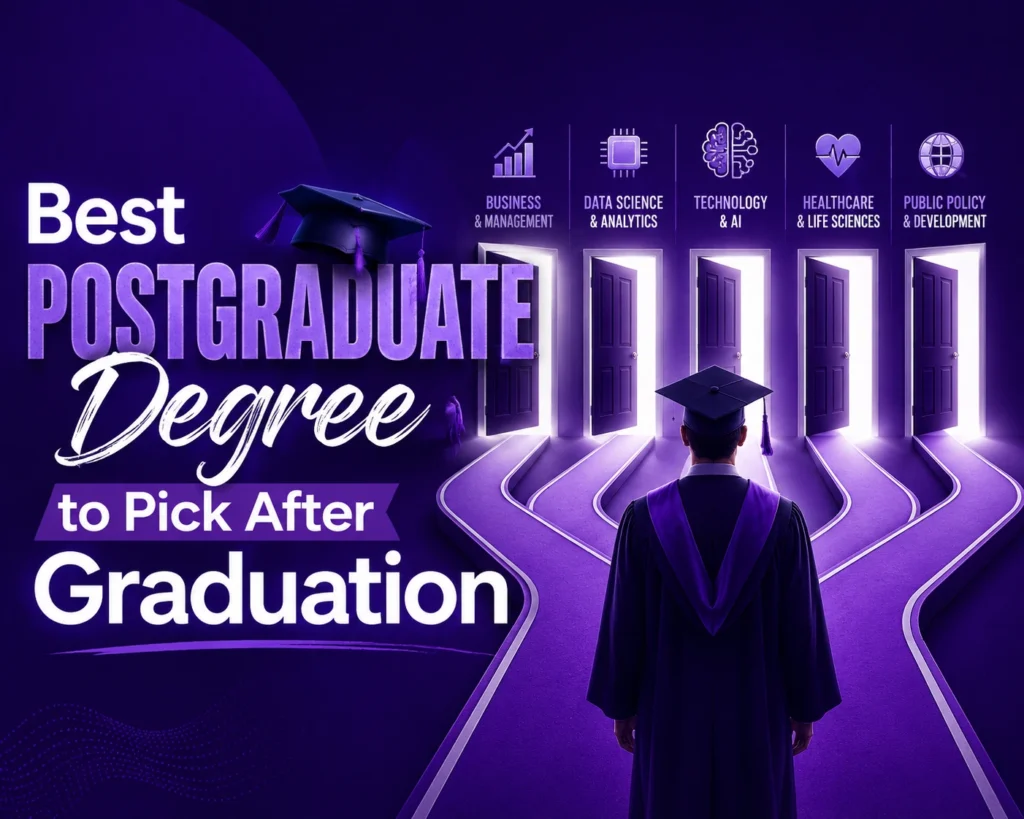
Finishing your undergraduate studies is a major milestone, but it often brings a bigger question: what comes next? For many students, the answer lies in pursuing a postgraduate degree. With so many options available across different fields, countries, and formats, choosing the right postgraduate degree can feel overwhelming.
This article breaks down everything you need to know about selecting the best postgraduate degree after graduation, no matter where you are in the world or what field you come from. Whether you are aiming for career advancement, deeper specialization, or a complete career switch, this will help you make a confident, informed decision.
What Is a Postgraduate Degree?
A postgraduate degree is any academic qualification pursued after completing a bachelor’s degree. It typically includes master’s programs, postgraduate diplomas, and doctoral degrees. Unlike undergraduate study, which builds foundational knowledge across a broad subject area, a postgraduate degree focuses on specialization, advanced research, and practical expertise in a specific field.
Postgraduate degrees are designed for students who want to deepen their understanding of a subject, gain a competitive edge in the job market, or transition into a completely new career path. They are recognized worldwide and form an important part of academic and professional growth across nearly every industry.
Why Pursue a Postgraduate Degree?
There are several strong reasons why graduates choose to continue their education with a postgraduate degree rather than entering the workforce immediately.
- Career advancement – Many leadership and specialized roles require a postgraduate degree as a minimum qualification. Industries like healthcare, engineering, finance, education, and research often prioritize candidates with advanced degrees.
- Higher earning potential – Across most global job markets, professionals with a postgraduate degree tend to earn more over their lifetime compared to those with only an undergraduate qualification.
- Specialized knowledge – A postgraduate degree allows you to focus deeply on a niche area, making you an expert rather than a generalist.
- Career change opportunities – If your undergraduate degree does not align with your desired career, a postgraduate degree can help you pivot into a new field without starting from scratch.
- Networking and global exposure – Postgraduate programs often connect you with professionals, researchers, and peers from around the world, opening doors to international opportunities.
Postgraduate Degree vs Undergraduate Degree
Understanding the difference between these two levels of study helps clarify why a postgraduate degree matters.
| Aspect | Undergraduate Degree | Postgraduate Degree |
|---|---|---|
| Duration | 3 to 4 years typically | 1 to 2 years for master’s, longer for doctoral |
| Focus | Broad foundational knowledge | Specialized, in-depth expertise |
| Learning Style | Lecture-based, structured | Research-driven, independent study |
| Career Impact | Entry-level roles | Mid to senior-level roles |
| Flexibility | Limited subject choice | Highly focused subject choice |
Types of Postgraduate Degrees You Can Choose From
One of the most important steps in this decision is understanding the different types of postgraduate degrees available globally.
- Master’s Degree – The most common postgraduate qualification, usually completed in one to two years. It includes options like a Master of Arts, Master of Science, or specialized professional master’s degrees.
- Postgraduate Diploma or Certificate – A shorter, more focused qualification that often serves as a stepping stone toward a full master’s degree or as a standalone professional credential.
- MBA (Master of Business Administration) – A popular postgraduate degree for those aiming for leadership and management roles across industries.
- Doctoral Degree (PhD) – The highest level of postgraduate study, focused on original research and academic contribution. This path suits those interested in academia, research, or highly specialized expert roles.
- Professional Postgraduate Degrees – These include fields like law, medicine, architecture, and engineering, where advanced study is often required for licensure or professional practice.
Postgraduate Degree Eligibility Checklist
Eligibility requirements vary by country, institution, and field, but most postgraduate programs share a common set of criteria. Use this general checklist to assess your readiness before applying.
| Requirement | What It Usually Involves |
|---|---|
| Minimum academic grade | A specific GPA or percentage from your bachelor’s degree, often a set minimum threshold |
| Entrance examinations | Standardized tests required by many universities, varying by field and country |
| Language proficiency | Proof of proficiency in the language of instruction, especially for international applicants |
| Work experience | Required for some programs, particularly MBA and executive-level options |
| Letters of recommendation | Academic or professional references supporting your application |
| Statement of purpose | A written document outlining your goals and reasons for applying |
| Portfolio or writing sample | Required for creative, design, or research-focused programs |
If you fall short in one area, such as a lower grade or limited work experience, many institutions still offer pathways. Bridging courses, foundation programs, or strong performance in entrance exams can sometimes offset gaps elsewhere in your application.
Postgraduate Degree vs Postgraduate Diploma
Many graduates use these two terms interchangeably, but they are not the same thing. Understanding the difference can help you choose the option that best fits your time, budget, and career goals.
| Aspect | Postgraduate Degree | Postgraduate Diploma |
|---|---|---|
| Duration | Usually 1 to 2 years | Usually 6 months to 1 year |
| Depth of Study | In-depth, includes thesis or research component in many cases | Shorter, more focused on practical or applied knowledge |
| Cost | Generally higher tuition | Generally more affordable |
| Recognition | Widely recognized globally; often required for senior or academic roles | Recognized within industry, but carries less weight for research or academic careers |
| Career Impact | Suited for long-term specialization, leadership, or research roles | Suited for quick upskilling or entering a new field faster |
| Progression | Can lead directly to a doctoral degree | Often used as a stepping stone toward a full postgraduate degree later |
A postgraduate diploma works better if you want to upskill quickly, switch industries without a long commitment, or test a new field before investing in a full postgraduate degree. It is also a practical choice for working professionals who need a flexible, shorter program alongside their job.
Some universities even allow you to start with a postgraduate diploma and later convert it into a full postgraduate degree by completing additional credits or a thesis, making it a low risk way to explore a new academic direction before fully committing.
Right Time to Pursue Postgraduate Degree
One of the most debated questions among graduates is timing. Should you continue straight into postgraduate study right after finishing your bachelor’s, or is it better to gain work experience first? Both paths have genuine merit, and the right choice depends on your goals and circumstances.
Going straight after graduation works well if you are still in an academic rhythm, have a clear career direction, or are pursuing a field where early specialization matters, such as research or academia. It also avoids the adjustment of returning to student life after years in a job.
Gaining work experience first offers a different set of advantages. It helps you apply to more competitive programs that value real world exposure, particularly for an MBA or other management focused advanced degree. Work experience also gives you clarity on what you actually want to specialize in, rather than choosing a program based on assumption.
Some fields naturally favor one path over the other. Research heavy disciplines like the sciences or law often reward early specialization, while business and leadership focused programs tend to favor candidates with at least two to three years of professional exposure. If you are unsure, consider these questions before deciding.
Do you have a clear sense of which industry or role you want to pursue? If yes, and your chosen field benefits from immediate depth, moving forward without delay can work in your favor. If you are still exploring options, a short period of work experience can help refine your direction and make your eventual application stronger.
There is no universally correct timing. What matters most is that you enter postgraduate study with clarity, not simply because it feels like the expected next step.
How to Choose the Best Postgraduate Degree After Graduation
Selecting the right postgraduate degree depends on several personal and professional factors. Here is a practical framework to guide your decision.
- Define your career goals – Before choosing a postgraduate degree, get clear on where you want to be in five or ten years. If you want to move into management, an MBA might be ideal. If you want to become a subject matter expert, a specialized master’s degree may suit you better.
- Evaluate your current skill gaps – Look at job descriptions in your desired field and identify the skills or qualifications you currently lack. A postgraduate degree should directly address these gaps.
- Research industry demand – Some postgraduate degrees have stronger job market demand than others. Look into employment trends, salary data, and growth projections in your chosen field.
- Consider format and flexibility – Decide whether a full time, part time, or online postgraduate degree fits your lifestyle, especially if you are working or have other commitments.
- Factor in cost and return on investment – A postgraduate degree is a financial investment. Compare tuition costs against expected salary increases and career opportunities it could unlock.
- Think about location and global recognition – Some postgraduate degrees hold more weight internationally than others. If you plan to work abroad, choose a program with strong global recognition.
Postgraduate Degree Options by Career Path
| Career Goal | Recommended Postgraduate Degree |
|---|---|
| Business leadership and management | MBA or Master of Management |
| Technology and data careers | Master of Science in Computer Science or Data Science |
| Healthcare and clinical roles | Master of Public Health or specialized clinical degrees |
| Academic or research careers | PhD or Master of Philosophy |
| Finance and investment roles | Master of Finance or Master of Economics |
| Education and teaching | Master of Education |
| Engineering specialization | Master of Engineering or Master of Technology |
| Law and legal practice | Master of Laws (LLM) |
Best Postgraduate Degree Based on Your Bachelor’s Degree
One of the easiest ways to shortlist the right postgraduate degree is to start from the bachelor’s degree you already hold. While career goals should always guide the final decision, your undergraduate background often opens natural pathways into certain postgraduate programs. Here is a general overview to help you connect the dots.
| Bachelor’s Degree | Recommended Postgraduate Degree | Why It Fits |
|---|---|---|
| BA (Bachelor of Arts) | MA, Master of Education, MBA | Builds on critical thinking, communication, and humanities knowledge; MBA suits those shifting to business roles |
| BSc (Bachelor of Science) | MSc, Master of Data Science, Master of Public Health | Strengthens technical and analytical skills in a specialized scientific field |
| BCom (Bachelor of Commerce) | Master of Finance, MBA, Master of Economics | Deepens financial and business expertise for corporate or analytical roles |
| BTech or BE (Engineering) | MTech, MS in Engineering, MBA | Enables deeper technical specialization or transition into engineering management |
| BBA (Bachelor of Business Administration) | MBA, Master of Management | Provides advanced leadership and strategic business skills |
| BCA or related Computer Applications degree | MCA, MSc Computer Science, Master of Data Science | Expands coding, software, and data expertise for tech-focused careers |
| LLB (Bachelor of Law) | LLM (Master of Laws) | Adds specialization in a specific area of law for litigation or corporate legal roles |
| BEd (Bachelor of Education) | MEd, Master of Educational Leadership | Prepares for senior academic or administrative roles in education |
| BA or BSc in Psychology | MA or MSc in Psychology, Master of Counseling | Builds clinical or applied expertise for advanced psychology careers |
| Bachelor of Fine Arts | Master of Fine Arts, Master of Design | Refines creative and technical skills for advanced artistic or design careers |
For example, a BA graduate with strong analytical interests might choose a Master of Data Science instead of an MA, while a BTech graduate drawn to business strategy might pursue an MBA rather than an MTech. The key is using your bachelor’s degree as a starting reference point, not a strict boundary.
Before finalizing your choice, ask yourself three questions. Did you enjoy the core subjects in your bachelor’s degree? Does your target career require deep specialization in the same field, or does it value broader skills? Are you open to building new skills from scratch if you choose a different path?
Answering these honestly will help you decide whether to continue down the same academic path or use your postgraduate degree as an opportunity to pivot.
Online vs On Campus Postgraduate Degree
With more flexible learning options available globally, many graduates now weigh the choice between online and traditional on campus postgraduate degrees.
Online postgraduate degrees offer flexibility, lower costs in many cases, and the ability to study while working. They are ideal for working professionals or those balancing other responsibilities.
On campus postgraduate degrees offer stronger networking opportunities, hands on access to faculty and resources, and may be preferred for research intensive or lab based fields.
Neither format is universally better. The right choice depends on your learning style, career stage, and the nature of your chosen field.
Funding Your Postgraduate Degree
Cost is often a major factor when choosing a postgraduate degree. Fortunately, there are several ways to fund your studies.
- Scholarships and grants – Many universities and external organizations offer merit based or need based scholarships specifically for postgraduate students.
- Assistantships – Research or teaching assistantships, common in many countries, can help offset tuition costs while providing valuable experience.
- Employer sponsorship – Some employers support employees pursuing a postgraduate degree, especially if it aligns with the organization’s needs.
- Education loans – Many graduates rely on student loans to fund a postgraduate degree, though it is important to calculate the long term return on investment before committing.
Researching funding options early can significantly reduce financial stress and make your postgraduate degree more accessible.
Common Myths About Postgraduate Degrees
There are several misconceptions that often discourage graduates from pursuing further education.
- Myth: A postgraduate degree guarantees a higher salary. While it often improves earning potential, success also depends on skills, experience, and the specific field chosen.
- Myth: You must pursue a postgraduate degree immediately after graduation. Many professionals gain valuable work experience first, which can actually strengthen their postgraduate applications and clarify their academic focus.
- Myth: Only academically gifted students should pursue a postgraduate degree. A postgraduate degree is about dedication and clear goals, not just academic excellence.
- Myth: All postgraduate degrees are equally valuable. The value of a postgraduate degree depends heavily on the field, institution reputation, and alignment with career goals.
Skills You Gain From a Postgraduate Degree
Beyond technical knowledge, a postgraduate degree builds a range of valuable skills that employers consistently look for.
Critical thinking and research ability improve significantly through independent study and analysis. Project management skills develop naturally through long term assignments and dissertations. Communication skills are sharpened through presentations, academic writing, and peer collaboration. Leadership and decision making abilities grow, particularly in programs that involve teamwork or case study analysis.
These transferable skills make postgraduate degree holders attractive candidates across diverse industries, even beyond their specific field of study.
Is a Postgraduate Degree Worth It?
This remains one of the most common questions among graduates. The answer depends on individual circumstances, but a few general patterns hold true globally.
A postgraduate degree tends to be worth it when it aligns closely with clear career goals, addresses a genuine skill gap, and offers strong return on investment relative to its cost. It is less valuable when pursued without direction, simply to delay entering the workforce, or in fields where practical experience matters more than formal qualifications.
Before committing, it helps to speak with professionals already working in your target field, review job market data, and honestly assess your own motivations for pursuing further study.
Mistakes to Avoid When Choosing a Postgraduate Degree
Even well intentioned students make avoidable errors when selecting their next academic step. Being aware of these common mistakes can save you time, money, and unnecessary stress.
- Choosing based on trends alone – Picking a field simply because it is popular or in demand right now, without considering your own interests or strengths, often leads to disengagement later.
- Ignoring return on investment – Not every advanced degree justifies its cost. Failing to compare tuition against realistic salary outcomes can leave you with debt and limited payoff.
- Skipping research on faculty and curriculum – A program’s reputation matters less than the actual quality of teaching, research opportunities, and industry connections it offers. Always review faculty profiles and course structure before committing.
- Following a friend’s choice – Choosing a program because someone you know is doing it, rather than evaluating your own goals, frequently leads to mismatched expectations.
- Overlooking accreditation and recognition – Studying at an institution that lacks proper accreditation can limit your career options later, particularly if you plan to work internationally.
- Underestimating the time commitment – Postgraduate study demands significant time and discipline, especially if combined with work. Underestimating this can affect both performance and wellbeing.
- Not speaking to alumni or current students – First hand insights from people who have completed the same program often reveal practical details that official brochures do not mention.
Avoiding these mistakes starts with slowing down and researching thoroughly rather than rushing into a decision based on convenience or external pressure.
Final Thoughts
Choosing the best postgraduate degree after graduation is a deeply personal decision that depends on your career goals, financial situation, and long term aspirations. There is no single right answer that works for everyone, but by evaluating your goals, researching your options, and understanding the value each path offers, you can make a decision that genuinely supports your future.
A postgraduate degree, when chosen thoughtfully, can open doors to specialized roles, higher earning potential, and meaningful professional growth, no matter where in the world you plan to build your career.